
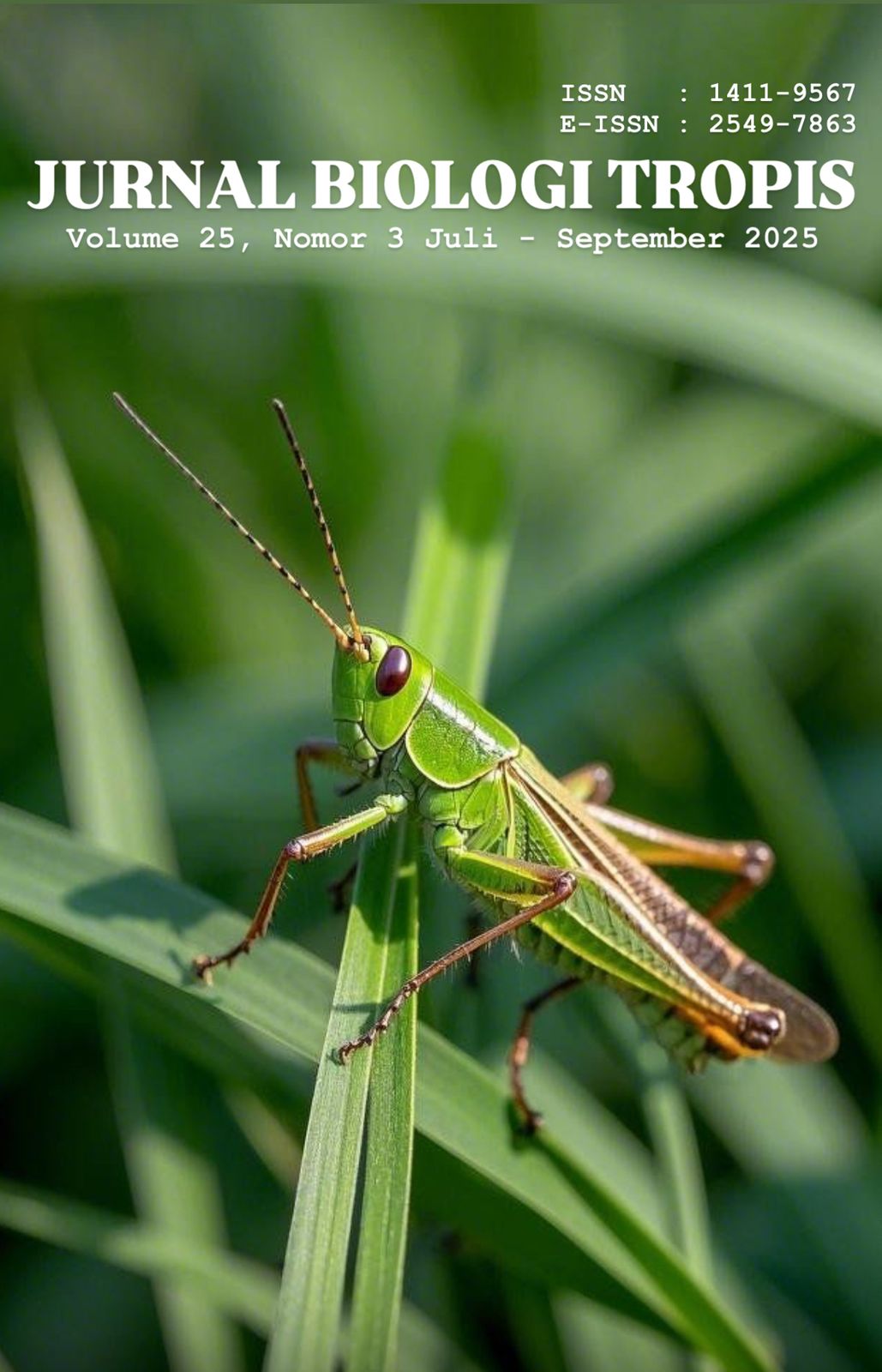
Effect of Indian Camphorweed (Pluchea indica) Leaves Ethanol Extract on rd3 Instar Larva Spodoptera litura Mortality
DOI:
10.29303/jbt.v25i3.11075Published:
2025-09-27Downloads
Abstract
Spodoptera litura, known as the tobacco cutworm or oriental leafworm moth, is a highly destructive, polyphagous pest that attacks over 250 crops, causing significant damage to leaves and making it a serious threat across Asia, Oceania, and Africa. To control the population of this species, the use of insecticides of plant origin is worth considering. Pluchea indica is a species known to contain secondary metabolites with insecticide properties. This study aimed to determine the effect of ethanol extract of indian camphorweed (Pluchea indica) leaves on rd3 instar larva Spodoptera litura mortality. This study used a completely randomized design (CRD) consisting of 6 concentrations of indian camphorweed (Pluchea indica) leaves ethanol extract, namely, 0, 250, 300, 350, 400, 450 and 500 ppm. Each treatment used 7 larvae with 5 repetitions. The mortality of larvae was observed for a 24-hour period by counting the number of nd2 instar larvae that died after having been treated. All data collected were analyzed with One-Way ANOVA. Statistical analysis showed that the ethanol extract of beluntas leaves significantly increases the nd2 instar larvae of S. litura mortality by 60.0% at a concentration of 500 ppm.
Keywords:
Bioinsecticide Pluchea indica Spodoptera lituraReferences
Abbot, W. S. (1925). A Method of Computing the Effectiveness of Incesticide. J. Econ. Entomol.
Ameriana, M. (2008). The behavior of vegetable farmers in using chemical pesticides. Journal of Horticulture,18(1):95 -106
Cui, C., Yang, Y., Zhao, T., Zou, K., Peng, C., Cai, H., Wang, X., Hou, R. (2019). Insecticidal Activity and Insecticidal Mechanism of Total Saponins from Camellia oleifera. Molecules, 24(24), 4518. Doi: 10.3390/molecules24244518
Dang, K., Doggett, SL., Singham, V., Lee, C. (2017). Insecticide Resistance Mechanism in Bed Bug, Cimex spp. (Hemiptera: Cimicidae). Parasites & Vectors,10(318). Doi: 10.1186/s13071-2232-3
Hardiyanti, D., Prafiadi, S., & Revisika, R. (2020). The effectiveness of the fruit filtrate of the crown of the god (Phaleria macro) as a bioinsecticide for the larvae of the pea caterpillar (Maruca testulalis) on the long bean plant (Vigna unguiculata). Journal of Biosilampari: Journal of Biology,3(1), 29-33. Doi: https://doi.org/10.31450/biosilampari.v3i1.886
Jannah, NAM, & Yuliani, Y. (2021). The Effectiveness of Pluchea indica and Chromolaena odorata Leaf Extracts as Bioinsecticides Against Mortality on Plutella xylostella Larvae. LenteraBio: Berkala Ilmiah Biologi, 10(1): 33-39. Doi: https://doi.org/10.26740/lenterabio.v10n1.p33-39
Khoyun, S. M. (2019). Effectiveness of beluntas leaf extract (Pluchea indica L.) as a natural insecticide on onion pests (Allium ascalonicum L.) Palu valley variety and its use as a learning medium (Doctoral dissertation, University). Tadulako
Marwoto & Suharsono. (2008). Strategy and Technology Components for Control of Gray Caterpillar (Spodoptera litura Fabricius) on Soybean Plants. J. Agricultural R&D. 27(4): 131-136.
Nurchayati, N., & Ardiyansyah, F. (2019). Local knowledge of food plants and their use in the Using Tribe, Banyuwangi Regency. Biotropics: Journal of Tropical Biology,7(1), 11-20. Doi: https://doi.org/10.21776/ub.biotropika.2019.007.01.02
Oyovki, MO., Atera, AD., Chimwuba, P., Joseph, UG. (2024). Implication of Pyrethroid Neurotoxicity for Human Health: A Lesson from Animal Model. Neurotox Res, 43(1), 1. Doi: 1007/s12640024007231
Palupi, B., Fachri, BA, Rahmawati, I., & Rizkiana, MF (2021). Increasing the capacity of the community in Pujer Baru village by using the beluntas plant as a raw material for essential oils and their derivatives. Devotion News,15(1), 10 21.
Rattan, MS. (2019). Mechanism of Action of Insecticidal Secondary Metabolites of Plant Origin. Crop Protection, 29 (9):913-920. Doi:10.1016/j.cropro.2010.05.008
Sa'diyah, NA, Purwani, KI, & Wijayanti, L. (2013). Effect of leaf extract of bintaro (Cerbera odollam) on the development of armyworm (Spodoptera litura F.).ITS Journal of Science and Arts,2(2), E111-E115. Doi: 10.35941/jatl.2.2.2020.2805.111-117
Syah, B. W., & Purwani, K. I. (2016). Pengaruh ekstrak daun belimbing wuluh (Averrhoa bilimbi) terhadap mortalitas dan perkembangan larva Spodoptera litura. Jurnal Sains dan Seni ITS, 5(2).
Tanian, MA., Rumiati, F., Susilowati, RP. (2023). Uji Neurotoksin Insektisida berbahan Ekstrak Daun Kemangi dan Piretrum terhadap Mortalitas Lalat Rumah (Musca domestica). Jurnal Kedokteran, 29(3). Doi:10.36452/jkdoktmeditek.v29i3.2636
Uge, E., Yusnawan, E., & Baliadi, Y. (2021). Environmentally Friendly Control of Caterpillar Pest (Spodoptera litura Fabricius) on Soybean Plants.Palawija Bulletin,19(1), 64-80. Doi: https://doi.org/10.21082/bulpa.v19n1.2021.p64-80
Uhan, TS (2008). Bioefficacy of several isolates of the entomopathogenic Steinernema spp. against Spodoptera litura Fabricius on chili plants in a greenhouse. Journal Horticulture,18(2).
Yuantari, MC, Widiarnako, B., & Sunoko, HR (2013). The level of knowledge of farmers in using pesticides (case study in Curut Village, Penawangan District, Grobogan Regency). In Proceedings of the National Seminar on Natural Resources and Environmental Management (Vol. 27, pp. 142-147).
License
Copyright (c) 2025 Syamsul Bahri, I Wayan Mertha, Khairuddin Khairuddin

This work is licensed under a Creative Commons Attribution 4.0 International License.

Jurnal Biologi Tropis is licensed under a Creative Commons Attribution 4.0 International License.
The copyright of the received article shall be assigned to the author as the owner of the paper. The intended copyright includes the right to publish the article in various forms (including reprints). The journal maintains the publishing rights to the published articles.
Authors are permitted to disseminate published articles by sharing the link/DOI of the article at the journal. Authors are allowed to use their articles for any legal purposes deemed necessary without written permission from the journal with an acknowledgment of initial publication to this journal.
























