
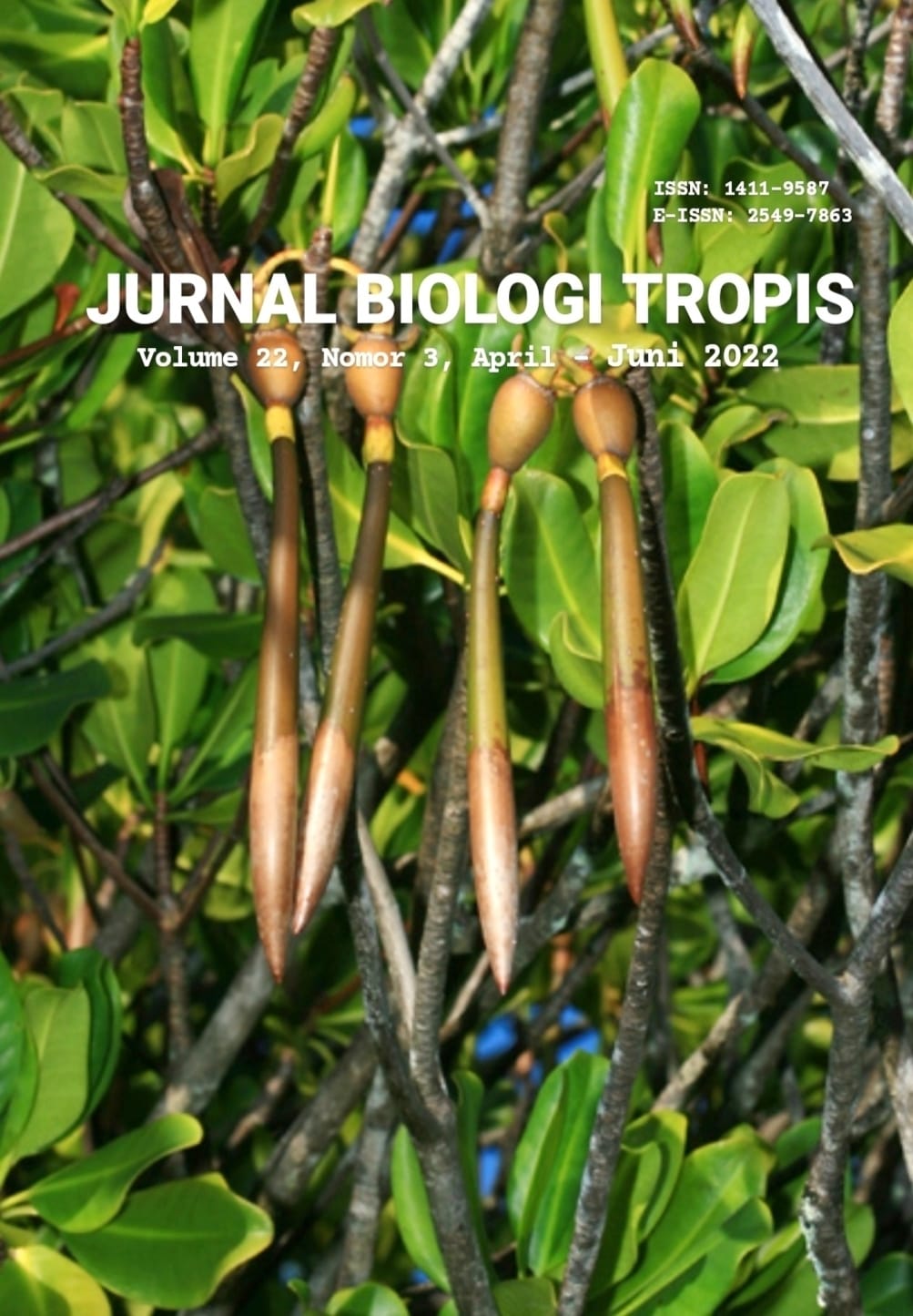
Inventory of Rare Fruit in Sibohe Forest of Singkawang City, West Kalimantan
DOI:
10.29303/jbt.v22i2.3114Published:
2022-03-18Downloads
Abstract
The location close to urban areas and the rapid rate of decline in area can threaten the diversity of rare fruits in the Sibohe Forest. A re-survey in the Sibohe Forest, Singkawang, West Kalimantan was conducted to confirm reports of the existence of 15 rare fruit plant species collected in 2017-2018 by previous researchers. The inventory process started from collection of specimens carried out during June-July 2021, herbarium making, identification and descriptive data analysis. Based on the similarity of regional names, 13 out of 15 species were confirmed according to the previous reports, while 2 species were not found due to the possibility of out of fruiting season. However, 4 of the 13 confirmed species were identified with different scientific names. Additional survey to the people in Pontianak City aged 17-34 years revealed some different names for the same type of fruit among these four species. Four new plant species were also collected and described in this study including amok (Alpinia sp., Zingiberaceae), nubik (Artocarpus sp., Moraceae), tehengan (Artocarpus sp., Moraceae), and smallest arok (Ficus sp., Moraceae). Potentials and challenges in the inventory of rare fruit plants in the Sibohe Forest should be studied regularly as well as efforts to increase public knowledge and interest, especially for the younger generation. Moreover, recommendation should be made to support conservation activities based on the actual data collected in the field regularly.
Keywords:
fruit rare fruit tropical fruit plant conservationReferences
Akhmadi, N.R. & Sumarmiyati (2015). Eksplorasi dan karakterisasi buah kapul (Baccaurea macrocarpa) di Kabupaten Kutai Barat, Kalimantan Timur. Pros. Sem. Nas. Masy. Biodiv. Indon. 1(4): 923-929. doi: 10.13057/psnmbi/m010448.
Bennett, B.C. & Balick, M.J. (2014). Does the name really matter? The importance of botanical nomenclature and plant taxonomy in biomedical research. J Ethnopharmacol.;152(3):387-92. doi: 10.1016/j.jep.2013.11.042. Epub 2013 Dec 7. PMID: 24321863.
Candramila, W., Erasmawanti, D., Sihombing, D.R., Hosniah, Gola, L., Magdalena. (2018). Perilaku Makan Masyarakat Pedesaan di Kalimantan Barat. AL-KAUNIYAH: Journal of Biology. 11(2): 190-207.
Daningsih, E. (editor). (2019). Morfologi dan Kandungan Nutrisi Buah Langka di Kalimantan Barat. Untan Press. Pontianak. ISBN: 978-623-7571-05-6.
Daningsih, E., Syamswisna, Titin. (2021). Buah Langka di Kalimantan Barat Jilid 2. Untan Press. Pontianak. ISBN: 978-623-7571-33-9.
DiTomaso, J.M. (1993). Problems associated with the use of common names in the identification of poisonous plants. Vet Hum Toxicol. 35(5):465-6. PMID: 8249273.
Henderson, A. (2020). A revision of Calamus (Arecaceae, Calamoideae, Calameae, Calaminae). Phytotaxa. Vol. 445. No. 1. DOI: https://doi.org/10.11646/phytotaxa.445.1.1
Khasbagan & Soyolt. (2008). Indigenous knowledge for plant species diversity: a case study of wild plants' folk names used by the Mongolians in Ejina desert area, Inner Mongolia, P. R. China. J Ethnobiol Ethnomed. 16; 4:2. doi: 10.1186/1746-4269-4-2. PMID: 18199323; PMCID: PMC2268917.
Normah, M. N., Clyde, M. M., Cho, E. G., & Ramanatha Rao, V. (2002). Ex Situ Conservation of Tropical Rare Fruit Species. Acta Horticulturae, (575), 221–230. doi:10.17660/actahortic.2002.575.23
Rivera, D., Allkin, R., Obon, C., Alcaraz, F., Verpoorte, R., & Heinrich, M. (2014). What is in a name? The need for accurate scientific nomenclature for plants. J. Ethnopharm. 152: 393-402. http://dx.doi.org/10.1016/j.jep.2013.12.022
Rustiami, H. (2011). Revision of Calamus and Daemonorops (Arecaceae) in Sulawesi. Disertasi, IPB, Bogor, Indonesia.
Susi. (2014). Potensi pemanfaatan nilai gizi buah eksotik khas Kalimantan Selatan. Ziraa’ah. 39(3): 144-150. https:// https://ojs.uniska-bjm.ac.id/index.php/ziraah/article/view/82
The Plant List: a working list of all plant species. http://www.theplantlist.org/tpl1.1/record/kew-55782. (Accessed on November 11, 2021)
License
Copyright (c) 2022 Wolly Candramila

This work is licensed under a Creative Commons Attribution 4.0 International License.

Jurnal Biologi Tropis is licensed under a Creative Commons Attribution 4.0 International License.
The copyright of the received article shall be assigned to the author as the owner of the paper. The intended copyright includes the right to publish the article in various forms (including reprints). The journal maintains the publishing rights to the published articles.
Authors are permitted to disseminate published articles by sharing the link/DOI of the article at the journal. Authors are allowed to use their articles for any legal purposes deemed necessary without written permission from the journal with an acknowledgment of initial publication to this journal.
























