
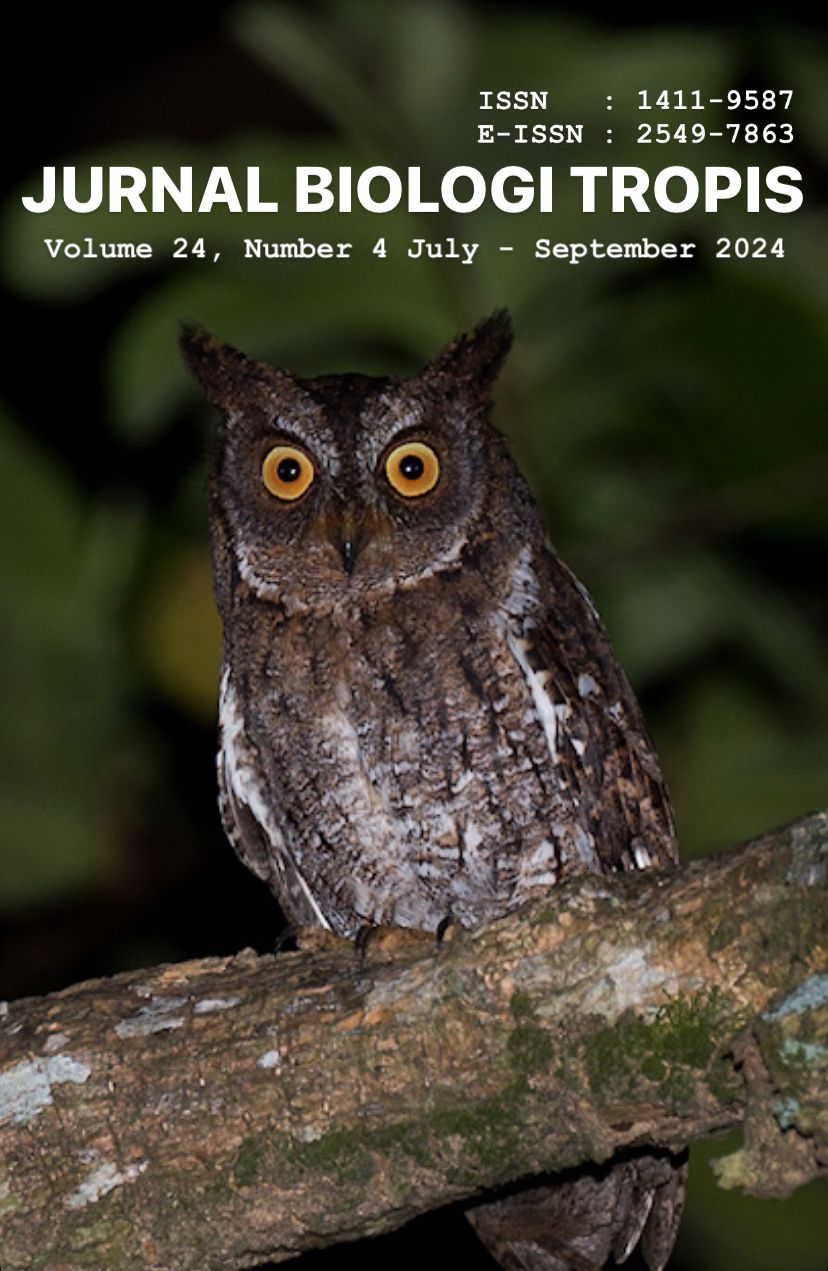
Ujung Kulon National Park Ecotourism as a Form of Public Conservation and Education Strategy for Endangered Animals: Literature Review
DOI:
10.29303/jbt.v24i3.7251Published:
2024-07-23Downloads
Abstract
The oldest national park in Indonesia is Ujung Kulon National Park and is the last habitat of Javan Rhinoceros and other endangered animals. Habitat degradation and overexploitation are the main factors in the extinction of endangered animals. The condition is getting worst because the lack of public awareness about the importance of conserving endangered animals and their habitats. The method for conducting this research was based on the literature study. The results of this research indicate that strategic conservation actions will be implemented through conservation management practices such as: (1) development of JRSCA for the Javan rhinoceros, (2) effectiveness of TNUK management, (3) intensification of protection and patrols, (4) law enforcement, (5) education and involvement of local communities, (6) development of ecotourism, (7) development of Mount Honje as a habitat for the Javan rhino, (8) rhino research program including population surveys, biological and ecological research, (9) translocation and release of the Javan Rhino to develop the Javan Rhino population which is decrease. Educational programs that can be carried out are: (1) Art books, (2) Educational Games Based on Android, (3) Illustrated books, (4) Merchandise, (5) TNUK endangered animal conservation campaigns.
Keywords:
Conservation strategy; ecotourism; public education; Ujung Kulon National ParkReferences
[BTNUK] Balai Taman Nasional Ujung Kulon. (2014). Laporan Monitoring Populasi Badak Jawa (Rhinoceros sondaicus) Tahun 2013. Labuan (ID): BTNUK.
[TPPMRTP JRSCA] Tim Pelaksana Penyempurnaan Manajemen dan Rencana Tapak Pembangunan Javan Rhino Study and Conservation Area (JRSCA). (2012). Penyempurnaan Manajemen dan Rencana Tapak Pembangunan Javan Rhino Study and Conservation Area (JRSCA). Pandeglang (ID): BTNUK.
[WWW] World Wide Fund for Nature. (2012). Javan Rhino Extinct in Vietnam. Journal Newsletter of WWF Singapore. Vol (2012):5.
Adisasmito, Nuning. D. (2002). Buku Seniman. Jurnal Wacana Seni Rupa.Vol. No.4.
Angela, V. F. (2023). Strategi Pengembangan Ekowisata dalam Mendukung Konservasi Alam Danau Tahai. JIM: Jurnal Ilmiah Mahasiswa Pendidikan Sejarah, 8(3), 984-993.
Azizah, M. N. L., Wulandari, D., & Marianti, A. (2021). Tantangan Mewujudkan Ekowisata Sungai Berkelanjutan untuk Meningkatkan Kesejahteraan Manusia dan Melindungi Keanekaragaman Hayati di Indonesia. Indonesian Journal of Conservation, 10(2), 72-77.
Balai Taman Nasional Ujung Kulon. (2012). Mengenal JRSCA (Javan Rhino Study and Conversation Area). http://www.ujungkulon.org
Basuni S, & Kosmaryandi N. (2008). Membangun Ekowisata di Hutan Konservasi. Di dalam Avenzora R, editor. Ekoturisme: Teori dan Praktek. NAD-Nias (ID): BRR.
Budianto, Immanuela Lesterina, Waluyanto Heru, & Zacky Aznar (2020). Perancangan Artbook Untuk Meningkatkan Awareness Masyarakat Terhadap Kelangkaan Fauna Indonesia. Jurnal DKV Adiwarna Universitas Kristen Petra. Vol. 1. No. 16.
Cole S. (2006). Cultural Tourism, Community, Participation and Empowerment. Di dalam: Smith MK dan Robinson M, editor. Tourism and Cultural Change: Cultural Tourism in a Changing World Politics, Participation and (Re)presentation 7th Ed. Britain (UK): Channel View Publications.
Damayanti. Akbar, Fadil Muhammad & Sulistiani, Hani (2020). Game Edukasi Pengenalan Hewan Langka Berbasis Android Menggunakan Construct 2. (2020). Jurnal Teknologi Informasi Dan Ilmu Komputer, 7(2), 275-282.
Ghunadi, Galih (2020). Perancangan Pusat Edukasi Satwa Langka Ujung Kulon Di Bandung. Other thesis, Univesitas Komputer Indonesia.
International Rhino Foundation [IRF]. (2010). Operation Javan rhino: providing a safety net for a species. Journal of Pamphlet distributed by IRF. Vol (-):1-5.
Janssens, B., & Trouwborst, A. (2018). Rhinoceros Conservation and International Law: The Role of Wildlife Treaties in Averting Megaherbivore Extinction. Journal of International Wildlife Law & Policy, 21(2–3), 146–189. https://doi.org/10.1080/13880292.2018.1483300
Muntasib EKSH. (2002). Penggunaan Ruang Habitat Oleh badak jawa (Rhinoceros sondaicus, Desm. 1822) di Taman Nasional Ujung Kulon [disertasi]. Bogor. (ID): Institut Pertanian Bogor.
Muttaqin T, Purwanto RH, & Rufiqo SN. (2011). Kajian Potensi dan Strategi Pengembangan Ekowisata di Cagar Alam Pulau Sempu Kabupaten Malang Provinsi Jawa Timur. GAMMA. 6(2):152 – 161.
Peraturan Pemerintah No. 7 Tahun 1999. Tentang Pengawetan Tumbuhan dan Satwa Liar.
Pratiwi, Novita (2019). Perancangan Buku Ilustrasi Satwa Langka Di Indonesia Dengan Teknik Digital Watercolor Sebagai Media Edukasi Anak Usia 6-12 Tahun. Ungraduate thesis, Fakultas Teknologi dan Informatika Institut Bisnis dan Informatika Stikom Surabaya.
Prensky, M. (2011). ‘From Digital Natives to Digital Wisdom’, From Digital Natives to Digital Wisdom, pp. 1–9.
Soehartono TR, Mardiastuti A. (2002). CITES and its Implementation in Indonesia Jakarta. Nagao Envitonment Foundation.
Sriyanto, Agoes & Haryono, Moh. (1997). PENGELOLAAN, STRATEGI DAN RENCANA TINDAKAN KONSERVASI BADAK JAWA DI TAMAN NASIONAL UJUNG KULON. Media Konservasi Edisi Khusus. Hal 78-79.
Suherman, S. (2016). PERSEPSI MASYARAKAT KAWASAN PENYANGGA TERHADAP PENGEMBANGAN KAWASAN TAMAN NASIONAL UJUNG KULON. UNES Journal of Scientech Research, 1(1), 051-064. Retrieved from https://ojs.ekasakti.org/index.php/UJSR/article/view/142
Surahman, Ade. (2014). PENGEMBANGAN EKOWISATA “JAVAN RHINO STUDY AND CONSERVATION AREA” DI TAMAN NASIONAL UJUNG KULON, BANTEN. Skripsi. Institut Pertanian Bogor: Bogor.
Taman Nasional Ujung Kulon (1997). Kondisi Umum Taman Nasional Ujung Kulon. https://tnujungkulon.menlhk.go.id/show/index/110/Kondisi-Umum. Diakses pada 26 Oktober 2023.
TN. UJUNG KULON (1996). Laporan Inventarisasi Badak Jawa, Proyek Pengembangan Taman Nasional Ujung Kulon - Desember 1996, Labuan.
License
Copyright (c) 2024 Firza Fauziah, Risci Afif Istiqomah, Dina Anggun Saputri, Anisatu Z. Wakhidah

This work is licensed under a Creative Commons Attribution 4.0 International License.

Jurnal Biologi Tropis is licensed under a Creative Commons Attribution 4.0 International License.
The copyright of the received article shall be assigned to the author as the owner of the paper. The intended copyright includes the right to publish the article in various forms (including reprints). The journal maintains the publishing rights to the published articles.
Authors are permitted to disseminate published articles by sharing the link/DOI of the article at the journal. Authors are allowed to use their articles for any legal purposes deemed necessary without written permission from the journal with an acknowledgment of initial publication to this journal.
























