
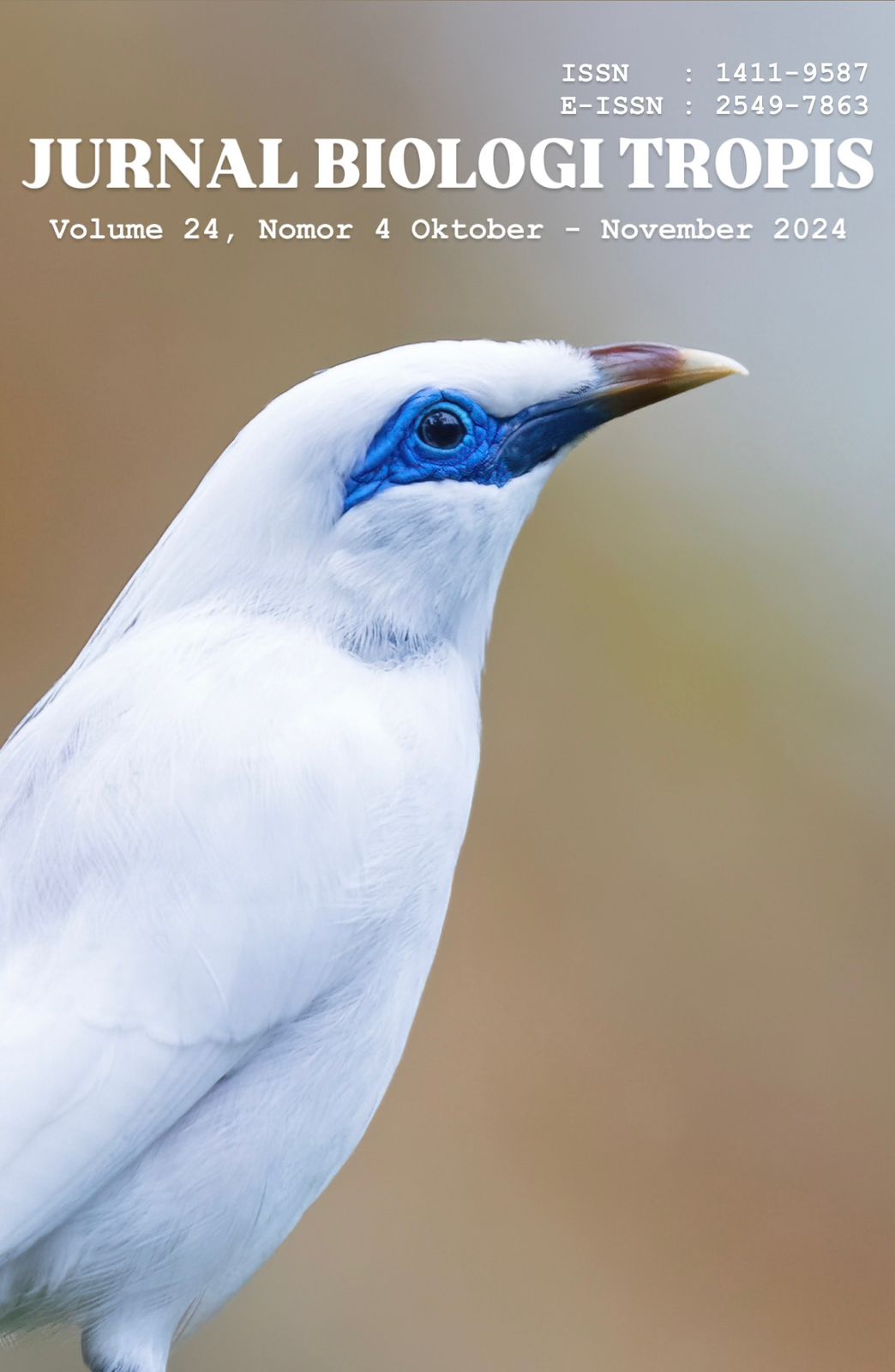
Characteristics of Orange-Footed Scrubfowl (Megapodius reinwardt) Nest in Tunak Montain Natural Tourism Park
DOI:
10.29303/jbt.v24i4.7622Published:
2024-10-08Downloads
Abstract
Orange-footed scrubfowl (Megapodius reinwardt) is a protected animal. Especially on the island of Lombok, one of the habitats of the orange-footed scrubfowl bird is in Tunak Montain Nature Tourism Park. The condition of the nest will influence the frequency of presence of orange-footed scrubfowl. In this regard, to enrich information in its conservation, it is necessary to carry out research on the characteristics of the nests of the orange-footed scrubfowl. The aim of this research to determine the nest characteristics of the orange-footed scrubfowl in Tunak Montain Nature Tourism Park. The method used is direct measurement and observation in the field. The results of the research show that the nest of the orange-footed scrubfowl bird is in the form of a mound of earth composed of leaves, branches, tree twigs, sand and rocks. The height of the nest mound ranges from 57-160 cm, and the diameter of the nest mound is 500-1,030 cm. The number of holes in each nest varies, namely between 5-9 holes, with a hole depth of 67-142 cm and a nest hole diameter of 30-41 cm. The dominant factors of the abiotic component of the nest that have a singular influence on the presence of orange-footed scrubfowl are distance to the river channel and number of predators. The tendency to choose a nesting area based on the results of Chi-Square analysis is influenced by five variables, namely, distance to the river, soil texture, altitude, temperature and number of predators around the nest.
Keywords:
Nest Characteristics, orange-footed scrubfowl (Megapodius reinwardt), Tunak Montain Natural Tourism Park.References
BKSDA NTB. (2012). Rencana Pengelolaan Taman Wisata Alam Gunung Tunak Kabupaten Lombok Tengah, Provensi Nusa Tenggara Barat, Periode Tahun 2012 s/d 2021. Kementerian Kehutanan. Kota Mataram
Dekker, R. W. R. J., & Brom, T. G. (1990). Maleo Eggs and The Amount of Yolk in Relation to Different Incubation Strategies in Megapodes. Aust. J. Zool. 38, 19–24.
Fryxell, J. M., Sinclair, A. R. E., & Caughley, G. (2014). Wildlife Ecology, Conservation, and Management (Third Edition). Hoboken: Hohn Wiley & Sons.
Harris, R. B., Birks, S. M., & Leaché, A. D. (2014). Incubator Birds: Biogeographical Origins and Evolution of Underground Nesting in Megapodes (Galliformes: Megapodiidae). Journal of Biogeography, 41(11), 2045–2056. https://doi.org/10.1111/jbi.12357
Hidayati, B. S. W. (1996). Perilaku Reproduksi dan Karakteristik Mikrohabitat Tempat Bertelur Burung Gosong (Megapodius reinwardtii Dummont 1823) di Taman Buru Pulau Moyo. Skripsi. Institut Pertanian Bogor.
Hidayati, Z. H., Silamon, R. F., & Syaputra, M. (2018). Karakteristik Sarang Burung Gosong Kaki Merah (Megapodius reinwardt) di Jalur Teluk Ujung Taman Wisata Alam Gunung Tunak. Skripsi. Universitas Mataram.
Hoyo, J. del, Elliott, A., & Sargatal, J. (1994). Handbook of The Birds of The World (Volume 2). Barcelona: Lynx Edicions.
Humaero, S., Candri, D. A., & Suana, I. W. (2023). Status Konservasi Burung yang Diperdagangkan di Pulau Lombok. Jurnal Bios Logos, 13(3), 180–191. https://doi.org/10.35799/jbl.v13i3.52103
IUCN. (2017). The Internasional Union for Conservation of Nature and Natural Resoueces (IUCN) Red List of Threatned Species. https://www.iucnredlist.org/. (Accessed on Jan 3, 2024)
Johnson, R. A., Bhattacharyya, G. K. (1992). Statistick, Principles and Methods. New York: Wiley.
Junaidi, K., & Irni, J. (2023). Analisis Keanekaragaman Jenis Tumbuhan Pakan Burung Gosong Kaki Merah (Megapodius reindwardt) Di Taman Wisata Alam Gunung Tunak. Agroprimatech, 6(2): 86-94.
Kalembiro, M., Rajamuddin, U. A., & Zaenuddin, R. (2018). Karakteristik Fisik Tanah pada Berbagai Kelerengan DAS Poboya Kota Palu. J. Agrotekbis, 6(6), 748–756.
Kanom, K., & Darmawan, R. N. (2020). Pengembangan Taman Wisata Alam Gunung Tunak Sebagai Destinasi Pariwisata Berkelanjutan. Jurnal Ilmiah Pariwisata, 25(2), 84. https://doi.org/10.30647/jip.v25i2.1390
Kesaulya, R. E., Latupapua, L., & Puttileihalat, M. (2023). Karakteristik Sarang Burung Gosong di Suaka Margasatwa Pulau Kasa. Jurnal Hutan Tropis, 11(1), 54. https://doi.org/10.20527/jht.v11i1.15992
Mujdalifah, I., Purnamasari, D. K., Syamsuhaidi, S., Sumiati, S., & Pardi, P. (2019). Inventarisasi dan Evaluasi Nutrisi Pakan Burung Gosong Kaki Merah (Megapodius reinwardt) Pada Pemeliharaan In-situ Di Taman Wisata Alam Keranjangan
Jurnal Ilmu Dan Teknologi Peternakan Indonesia (JITPI), Indonesian Journal of Animal Science and Technology, 4(2), 297. https://doi.org/10.29303/jitpi.v4i2.48
Oktovianus, Arief, H., Hikmat, A., Hernowo, J. B. & Hermawan, R. (2017). Analisis Keanekaragaman Jenis Tumbuhan Pakan Burung Gosong Kaki Merah (Megapodius reinwardt) di Taman Wisata Alam Gunung Tunak. Agroprimatech, 1(1): 10-17.
Palmer, C., Christian, K. A., & Fisher, A. (2000). Mound Characteristics and Behaviour of the Orange-footed Scrubfowl in the Seasonal Tropics of Australia. Emu - Austral Ornithology, 100(1), 54–63. https://doi.org/10.1071/MU9853
Panggur, M. R. (2008). Karakteristik Gundukan Bertelur dan Perilaku Bertelur Burung Gosong Kaki-Merah (Megapodius reinwardt Dumont 1823) di Pulau Rinca, Taman Nasional Komodo. Skripsi. Institut Pertanian Bogor.
Pratama, A. A., Alpiansah, R., Yuliana, I., & Hermanto, A. (2023). Potret Pengelolaan Berkelanjutan Taman Wisata Alam Gunung Tunak Kabupaten Lombok Tengah. Target: Jurnal Manajemen Dan Bisnis, 5(1), 39–46. https://doi.org/10.30812/target.v5i1.2881
Purwanto, K. S., Kaliky, F., & Karepesina, S. (2023). Inventarisasi Populasi dan Karakteristik Habitat Burung Gosong Kelam (Megapodius freycinet) di Suaka Margasatwa (SM) Pulau Kassa Kabupaten Seram Bagian Barat. Jurnal Agrohut, 14(2), 85–109. https://doi.org/10.51135/agh.v14i2.183
Puspitasari, F. L., Syaputra, M., & Hadi, I. (2023). Mikrohabitat sarang burung gosong kaki merah (Megapodius reinwardt) di zona pemanfaatan Pulau Satonda Taman Nasional Moyo Satonda. ULIN: Jurnal Hutan Tropis, 7(2), 255. https://doi.org/10.32522/ujht.v7i2.12668
Tagueha, A. D., & Liur, I. J. (2021). Pengetahuan dan Sikap Masyarakat di Kecamatan Seram Utara Barat, Provinsi Maluku, Terhadap Keberadaan Burung Gosong. Biota: Jurnal Ilmiah Ilmu-Ilmu Hayati, 99–108. https://doi.org/10.24002/biota.v5i2.3619
Tvardikova, K. (2013). Trophic Relationships Between Insectivorous Birds and Insect in Papua New Guinea. Dissertation. University of South Bohemia.
Yamin, M., Jufri, A. W., Hakim, A., Gunawan, G., Rahmat, J., & Sukarso, A. A. (2024). Nest characteristics, distribution, and preferences of Megapodius reinwardt as the basis for its conservation on Lombok Island, West Nusa Tenggara, Indonesia. Biodiversitas Journal of Biological Diversity, 25(5). https://doi.org/10.13057/biodiv/d250508
Yuningsih, A., Hadi, I., & Syaputra, M. (2018). Populasi dan Karakteristik Gundukan Sarang Burung Gosong Kaki-Merah (Megapodius reinwardt) di Kawasan Tanjung Pasir Taman Buru Pulau Moyo. Skripsi. Universitas Mataram
License
Copyright (c) 2024 Anisa Hasbudiana, M. Yamin, Jamaluddin Jamaluddin

This work is licensed under a Creative Commons Attribution 4.0 International License.

Jurnal Biologi Tropis is licensed under a Creative Commons Attribution 4.0 International License.
The copyright of the received article shall be assigned to the author as the owner of the paper. The intended copyright includes the right to publish the article in various forms (including reprints). The journal maintains the publishing rights to the published articles.
Authors are permitted to disseminate published articles by sharing the link/DOI of the article at the journal. Authors are allowed to use their articles for any legal purposes deemed necessary without written permission from the journal with an acknowledgment of initial publication to this journal.
























