
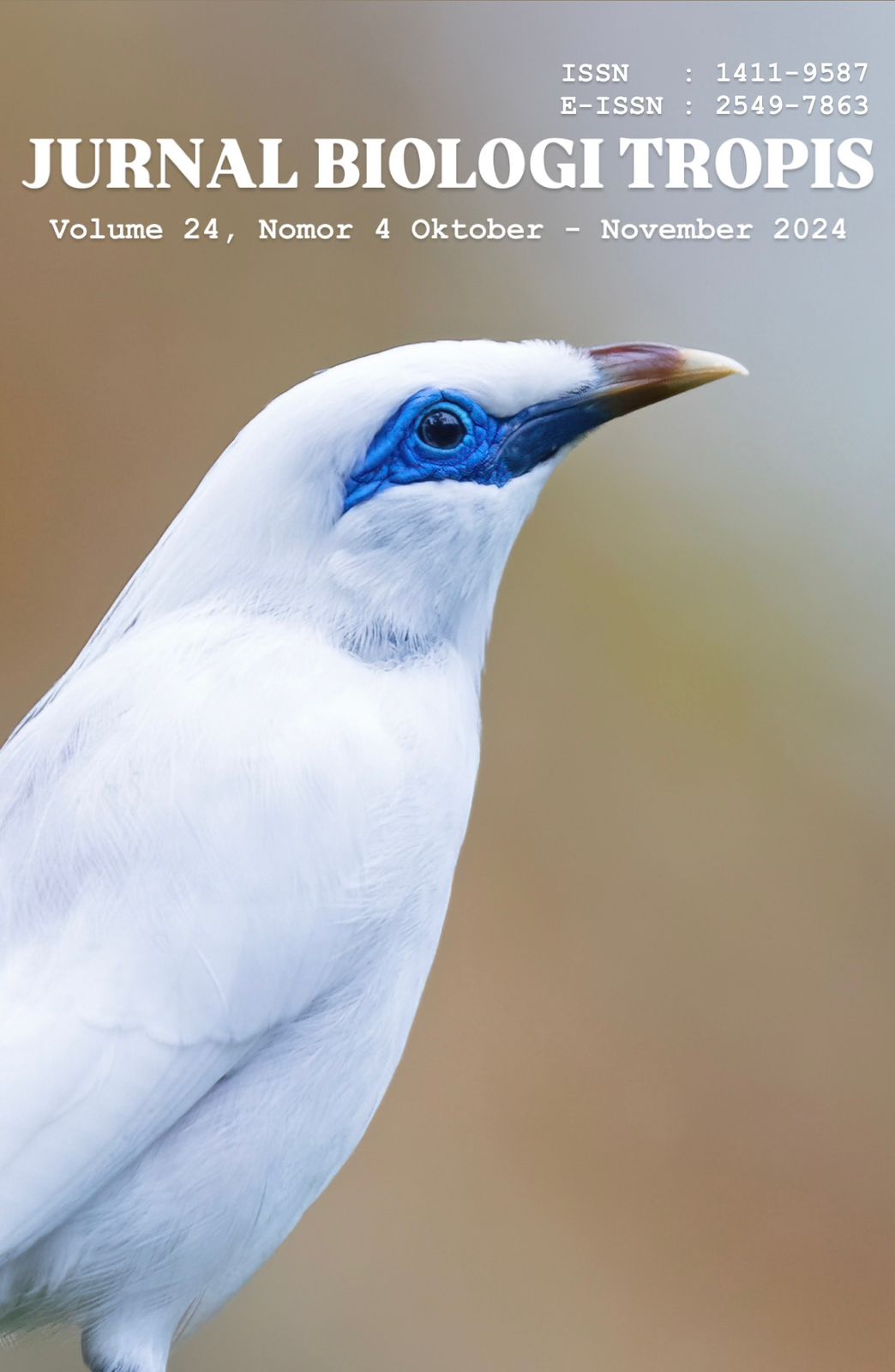
Estimation of Carbon Content in Mangrove Stands in The Santong Bay Mangrove Ecotourism Area Sumbawa Regency
DOI:
10.29303/jbt.v24i4.7917Published:
2024-10-02Downloads
Abstract
This study aims to analyze the vegetation composition, estimate biomass content, and examine carbon storage in mangrove stands in the Mangrove Ecotourism Area of Teluk Santong. The research employs a descriptive method to provide insights into natural phenomena or community relations by studying existing issues based on collected data, which is then processed through data presentation, analysis, and drawing conclusions. *Rhizophora apiculata* species dominate the mangrove area, with the highest Importance Value Index (IVI) for tree level reaching 365.50%. The estimated carbon stored in the mangrove stands is 3.07 tons/ha, with a biomass of 6.53 tons/ha and carbon dioxide storage of 76.52 tonsCO₂/ha. Carbon storage in a particular mangrove species increases with the growth in individual tree diameter. *Rhizophora apiculata* has higher density, diameter, and biomass values than *Avicennia alba*. Additionally, the CO₂ absorption capacity of *Rhizophora apiculata* is much higher than that of *Avicennia alba*, reaching 69 tons CO₂/ha.
Keywords:
Carbon content, ecotourism, mangrove stands.References
Ahyar, H., & Andriani, H. (2020). J., Utami, EF, Sukmana, DJ, & Istiqomah, RR (2020). Buku Metode Penelitian Kualitatif & Kuantitatif, 180-191.
Annisa, N. S. (2016). Analisis Vegetasi Tumbuhan Pantai Pada Kawasan Wisata Pasir Jambak, Kota Padang (Doctoral Dissertation, Universitas Andalas).
Fachrul. M. F. (2007). Metode Sampling Bioekologi. Bumi Aksara. Jakarta
Fhadil, M., Hardiwinoto, S., Indrioko, S., & Budiadi. (2017). Korelasi Antara Diameter dan Kerapatan Tegakan Jati Unggul Nomor Klon 97 dan 110 pada Umur 10 Tahun di KPH Ngawi, Perhutani Jawa Timur. Jurnal Ilmu Pertanian dan Lingkungan.13(2). 21-25.
Imran, A., & Efendi, I. (2016). Inventarisasi mangrove di pesisir pantai cemara Lombok Barat. JUPE: Jurnal Pendidikan Mandala, 1(1), 105-112.
Manafe, G., Kaho, M. R., Risamasu, F., & Adisucipto, J. (2016). Estimasi biomassa permukaan dan stok karbon pada tegakan pohon Avicennia marina dan Rhizophora mucronata di perairan pesisir oebelo Kabupaten Kupang. Jurnal Bumi Lestari, 16(2), 163-173.
Nahlunnisa, H., Zuhud, E. A., & Santosa, Y. (2016). Keanekaragaman spesies tumbuhan di arealnilai konservasi tinggi (nkt) perkebunan kelapa sawit provinsi riau. Media Konservasi, 21(1), 91-98.
Oktaviani, S. I., Hanum, L., & Negara, Z. P. (2018). Analisis Vegetasi di Kawasan Terbuka Hijau Industri Gasing. Jurnal Penelitian Sains, 19(3), 124-131.
Purwanza, S. W. (2022). Metodologi penelitian kuantitatif, kualitatif dan kombinasi. Cv. Media Sains Indonesia.
Wijayani, S., & Masrur, M. A. (2022). Indeks Nilai Penting dan Keanekaragaman Komunitas Vegetasi Penyusun Hutan di Alas Burno SUBKPH Lumajang. Jurnal Wana Tropika, 12(2), 80-89.
Takarendehang, R., Sondak, C. F., Kaligis, E., Kumampung, D., Manembu, I. S., & Rembet, U. N. (2018). Kondisi ekologi dan nilai manfaat hutan mangrove di desa Lansa, kecamatan Wori, kabupaten Minahasa Utara. Jurnal Pesisir dan Laut Tropis, 2. https://doi.org/10.35800/jplt.6.2.2018.21526.
Valentino, N., Latifah, S., Setiawan, B., Aji, I. M. L., & Hadi, M. A. (2022). Bioprospection of Potential Medicinal Plant Diversity in the Wana Lestari Community Forest, Karang Sidemen Village. Jurnal Penelitian Pendidikan IPA, 8, 101-111.
License
Copyright (c) 2024 Desti Suci Safitri, Sitti Latifah, Niechi Valentino

This work is licensed under a Creative Commons Attribution 4.0 International License.

Jurnal Biologi Tropis is licensed under a Creative Commons Attribution 4.0 International License.
The copyright of the received article shall be assigned to the author as the owner of the paper. The intended copyright includes the right to publish the article in various forms (including reprints). The journal maintains the publishing rights to the published articles.
Authors are permitted to disseminate published articles by sharing the link/DOI of the article at the journal. Authors are allowed to use their articles for any legal purposes deemed necessary without written permission from the journal with an acknowledgment of initial publication to this journal.
























