
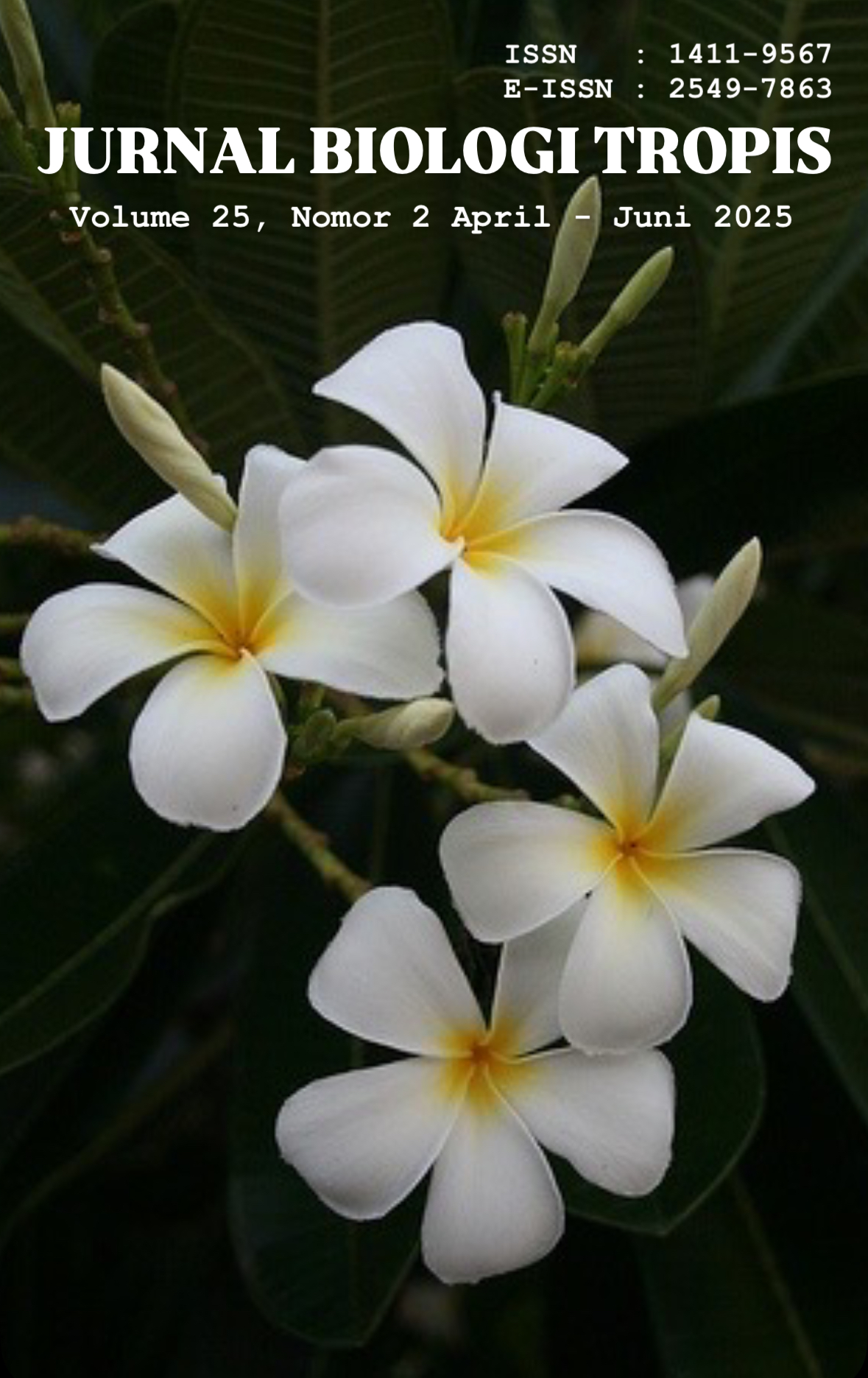
Potential of Ipomoea pes-caprae Extract as an Antibacterial: A Literature Review
DOI:
10.29303/jbt.v25i2.8839Published:
2025-04-30Downloads
Abstract
The increasing prevalence of antibiotic resistance shows the urgent need for discovering alternative compounds with potential antibacterial activity. Ipomoea pes-caprae (commonly known as katang-katang) has emerged as a promising natural source of antibacterial agents due to its bioactive constituents, including phenolics, alkaloids, flavonoids, and saponins. The purpose of this article is to review and compare previously reported antibacterial research findings of Ipomoea pes-caprae against various bacterial species. The literature review was conducted using relevant sources obtained from Google Scholar and PubMed databases, covering publications from 2014 to 2024. The findings show that different parts of Ipomoea pes-caprae exhibit antibacterial activity against both Gram-positive and Gram-negative bacterial strains, attributed to the presence of antibacterial compounds. Factors influencing the antibacterial activity of the extracts include the type of test bacteria, the extract concentration, and the solvent used. It can be concluded that Ipomoea pes-caprae has potential as an antibacterial agent.
Keywords:
Antibacterial, extract, Ipomoea pes-caprae.References
Adisti, J. P., Suwirmen, S., & Idris, M. (2023). The Effect of Centella (Centella asiatica (L.) Urb.) Extract with Several Types of Solvents as a Biostimulant on the Growth of Pagoda Mustard (Brassica rapa var. narinosa L.). Jurnal Biologi UNAND, 11(1), 54. https://doi.org/10.25077/jbioua.11.1.54-61.2023
Akinniyi, G., Lee, J., Kim, H., Lee, J. G., & Yang, I. (2022). A Medicinal Halophyte Ipomoea pes-caprae (Linn.) R. Br.: A Review of Its Botany, Traditional Uses, Phytochemistry, and Bioactivity. Marine Drugs, 20(5). https://doi.org/10.3390/md20050329
Alminsyah, Hafizah, I., & Sulastrianah. (2014). Uji Daya Hambat Ekstrak Daun Tapak Kuda (Ipomoea pes caprae (L) R. Br. ) Terhadap Staphylococcus aureus. Medula, 2(Vol 2, No 1 (2014)), 91–96. https://doi.org/10.33772/medula.v2i1.240
Andayani, D., & Hardiyanti, N. (2018). Efektivitas Daun Katang-Katang (Ipomoea pes-caprae L.Sweet) dalam Menghambat Nyeri pada Fase 1 dan Fase 2 dengan Metode Licking Time pada Mencit Jantan. Jurnal Penelitian Dan Kajian Ilmiah Kesehatan, 4(2), 83–89. https://doi.org/https://doi.org/10.33651/jpkik.v4i2.28
Anggraeni Putri, P., Chatri, M., & Advinda, L. (2023). Karakteristik Saponin Senyawa Metabolit Sekunder pada Tumbuhan. Jurnal Serambi Biologi, 8(2)(2), 251–258. https://doi.org/https://doi.org/10.24036/srmb.v8i2.207
Artaningsih, N. L. B., Habiba, N., & Mastra, N. (2018). Aktivitas Antibakteri Ekstrak Etanol Daun Gamal (Gliricidia sepium) pada Berbagai Konsentrasi terhadap Pertumbuhan Bakteri Streptococcus mutans secara In-Vitro. Jurnal Kesehatan, 9(3), 336–345. https://doi.org/https://doi.org/10.26630/jk.v9i3.967
Astriani, A. D., Djide, M. N., & Usia, N. A. (2022). Aktivitas Antibakteri Ekstrak Etanol 70% Daun Katang-Katang (Ipomea pes-caprae (L.) R. Br.) Asal Kecamatan Namlea Kabupaten Buru Maluku Terhadap Pertumbuhan Staphylococcus aureus. Journal Farmasi Dan Bahan Alam, 10(1), 16–24. https://journal-uim-makassar.ac.id/index.php/farbal/article/view/989
Bucataru, C., & Ciobanasu, C. (2024). Antimicrobial peptides: Opportunities and challenges in overcoming resistance. Microbiological Research, 286(April), 127822. https://doi.org/10.1016/j.micres.2024.127822
Darwati, H., Rosmiyati, M., & Destiana, D. (2022). Deskripsi Vegetasi Zona Inti Pantai Peneluran Penyu, Desa Sebubus, Kabupaten Sambas. Jurnal Hutan Lestari, 10(1), 220. https://doi.org/10.26418/jhl.v10i1.51068
Eijaz, S., Khan, M., Perveen, A., Mansuri, S., Nadir, M., & Baloch, M. N. (2019). Effect of Ipomoea Pes-Caprae (Linn.) R. Br. Stemand Root Extracts on Different Clinical Bacterial Isolates. International Journal of Advanced Research, 7(3), 676–684. https://doi.org/10.21474/ijar01/8687
Ethalsha, P., & Retna, A. M. (2015). In vitro studies of antibacterial and antioxidant activity of Ipomoea pes-caprae root extracts. World Journal of Pharmaceutical Sciences, 3(3), 622–627. https://wjpsonline.com/index.php/wjps/article/view/in-vitro-studies-antibacterial-antioxidant-ipomoea-pes-caprae
Iskandar, K., Murugaiyan, J., Halat, D. H., Hage, S. El, Chibabhai, V., Adukkadukkam, S., Roques, C., Molinier, L., Salameh, P., & Van Dongen, M. (2022). Antibiotic Discovery and Resistance: The Chase and the Race. Antibiotics, 11(2), 1–38. https://doi.org/10.3390/antibiotics11020182
Islamy, R. A., Hasan, V., Mamat, N. B., Kilawati, Y., & Maimunah, Y. (2024). Various Solvent Extracts Of Ipomoea Pes-Caprae: A Promising Source Of Natural Bioactive Compounds Compare With Vitamin C. Iraqi Journal of Agricultural Sciences, 55(5), 1602–1611. https://doi.org/10.36103/5vd4j587
Kiriwenno, J. V., Yunita, M., & Latuconsina, V. Z. (2021). Perbandingan Aktivitas Antibakteri Antara Ekstrak Daun Katang-Katang (Ipomoea pes-caprae L.) dan Minyak Seith Terhadap Pertumbuhan Staphylococcus aureus. Majalah Farmaseutik, 17(1), 122. https://doi.org/10.22146/farmaseutik.v17i1.58292
Kumar, A., Paul, S., Pingalkumari, Thirugnanasambandan Somasundaram, S., & Kathiresan, K. (2014). Antibacterial and phytochemical assessment on various extracts of Ipomoea pes-caprae (L.) R. Br through FTIR and GC- MS spectroscopic analysis. Asian Journal of Pharmaceutical and Clinical Research, 7(3), 134–138. https://journals.innovareacademics.in/index.php/ajpcr/article/download/1188/818
Linggar, E. Z. E. S., Astuty, E., & Taihuttu, Y. M. J. (2021). Uji Daya Hambat Ekstrak Etanol Daun Tapak Kuda Ipomoea pes-caprae Terhadap Pertumbuhan Bakteri Propionibacterium acne. Jurnal Ilmu Alam Dan Lingkungan, 12(1), 34–38. https://journal.unhas.ac.id/index.php/jai2/article/view/13094
Lisnasari, B. R. W. (2023). Farmakokinetika Dan Pendosisan Gentamisin Pada Pasien Pediatri Pharmacokinetics And The Dosing Of Gentamicin In Pediatric Patients. Jurnal Farmasi Tinctura, 4(2), 78–90. https://doi.org/https://doi.org/10.35316/tinctura.v4i2.2620
Muteeb, G., Rehman, M. T., Shahwan, M., & Aatif, M. (2023). Origin of Antibiotics and Antibiotic Resistance, and Their Impacts on Drug Development: A Narrative Review. Pharmaceuticals, 16(11), 1–54. https://doi.org/10.3390/ph16111615
Muttaqin, A. Z., Abun, A., & Sujana, E. (2022). Pengaruh Jenis Pelarut pada Ekstraksi Jahe Merah (Zingiber officinale var. rubrum) terhadap Aktivitas Bakteri Penyebab Penyakit pada Hewan Ternak In Vitro. Bioscientist : Jurnal Ilmiah Biologi, 10(2), 746. https://doi.org/10.33394/bioscientist.v10i2.5823
Nagababu P., & Umamaheswara Rao V. (2015). Pharmacological potential of Ipomea pes-caprae (L.) R. Br. whole plant extracts. Der Pharmacia Sinica, 6(2)(2), 52–60. https://www.imedpub.com/abstract/pharmacological-potential-of-ipomeapescaprael-r-br-whole-plant-extracts-11677.html
Nurbayani, N., Masriadi, M., & Gobel, F. A. (2023). Studi in Vivo Pengaruh Pemberian Ekstrak Daun Katang - Katang (Ipomoea Pes-Caprae) Terhadap Penyembuhan Luka Diabetes Melitus. Jurnal Kesehatan Tambusai, 4(3), 2400–2408. https://doi.org/10.31004/jkt.v4i3.16650
Nuskiya, A., Sibero, M. T., Setyati, W. A., Andriani, C., & Hendryanti, D. N. (2023). Bioprospecting of katang-katang leaves (Ipomoea pes-caprae) from Sumba Island, East Nusa Tenggara: Antimicrobial, antioxidant and secondary metabolites content. IOP Conference Series: Earth and Environmental Science, 1260(1), 0–10. https://doi.org/10.1088/1755-1315/1260/1/012054
Putri, O. S., & Yusran, D. I. (2023). Efektivitas antibakteri ekstrak daun bunga Lili Perdamaian (Spathiphyllum sp) terhadap pertumbuhan Staphylococcus aureus. Borneo Journal of Science and Mathematics Education, 3(2), 81–92. https://doi.org/https://doi.org/10.21093/bjsme.v3i2.6239
Putri, S. W. K., Nurhasana, D., Avidlyandi, A., Gustian, I., Sipriyadi, S., & Adfa, M. (2021). Aktivitas Antibakteri Ekstrak Etanol Daun Tapak Kuda (Ipomea pes-caprae (L.) R. Br.) Terhadap Bakteri Staphylococcus epidermidis. Jurnal Pendidikan Biologi Dan Sains, 4(2), 355–362. https://doi.org/https://doi.org/10.31539/bioedusains.v4i2.2864
Rahman, S., Sadaf, S., Hoque, M. E., Mishra, A., Mubarak, N. M., Malafaia, G., & Singh, J. (2024). Unleashing the promise of emerging nanomaterials as a sustainable platform to mitigate antimicrobial resistance. RSC Advances, 14(20), 13862–13899. https://doi.org/10.1039/d3ra05816f
Raut, N. S., Musle, R., Raut, M., Kanchhul, R. M., Taywade, E. S., & Umekar, M. J. (2023). Sustainable Antimicrobial Nanomaterials: A Promising Treatment for Multiple Drug Resistant Microorganisms. Indian Journal of Pharmaceutical Education and Research, 57(4), 937–950. https://doi.org/10.5530/ijper.57.4.115
Saimima, N. A., & Manuhuttu, D. (2021). Potensi Ekstrak Daun Tapak Kuda (Ipomoea pes-caprae) Sebagai Antibakteri Patogen Pangan. Journal of Aceh Aquatic Science Available Online At, 5, 1–19. https://doi.org/https://doi.org/10.35308/jaas.v5i1.3573
Saptowo, A., Supriningrum, R., & Supomo, S. (2022). UJI AKTIVITAS ANTIBAKTERI EKSTRAK KULIT BATANG SEKILANG (Embeliaborneensis Scheff) TERHADAP BAKTERI Propionibacterium acnes dan Staphylococcus epidermidis. Al-Ulum: Jurnal Sains Dan Teknologi, 7(2), 93. https://doi.org/10.31602/ajst.v7i2.6331
Sharma, D., Gautam, S., Singh, S., Srivastava, N., Khan, A. M., & Bisht, D. (2024). Unveiling the nanoworld of antimicrobial resistance: integrating nature and nanotechnology. Frontiers in Microbiology, 15(January). https://doi.org/10.3389/fmicb.2024.1391345
Sheeba, N., Mary, V. J., Mettilda Bai, M., & Paul, J. V. (2019). Phytochemical Analysis and Biomedical Applications of Ipomoea pescaprae Flower Extract-An In Vitro. International Journal of Pharmacy and Biological Sciences-IJPBS TM, 9(1), 9. https://ijpbs.com/ijpbsadmin/upload/ijpbs_5c67771bec5b8.pdf
Uthayam, C. M., & Vijayarengan, P. (2019). Antimicrobial Activity of Ipomoea pes-caprae L. against Selected Microbial Species. International Journal of Scientific Research in Science and Technology, 6(2), 616–623. https://doi.org/10.32628/ijsrst1962134
Wibowo, R. H., Nabella, I., & Fitri, S. (2024). Antibacterial Activity of Ethanol Extracts from Leaves and Flowers of Katang-Katang Ipomoea pes-caprae ( L ) R . Br Against Pseudomonas aeruginosa. Jurnal Pembelajaran Dan Biologi Nukleus, 10(1), 85–95. https://doi.org/https://doi.org/10.36987/jpbn.v10i1.4779
License
Copyright (c) 2025 Imasayu Nuralyza, Nisa Isneni Hanifa

This work is licensed under a Creative Commons Attribution 4.0 International License.

Jurnal Biologi Tropis is licensed under a Creative Commons Attribution 4.0 International License.
The copyright of the received article shall be assigned to the author as the owner of the paper. The intended copyright includes the right to publish the article in various forms (including reprints). The journal maintains the publishing rights to the published articles.
Authors are permitted to disseminate published articles by sharing the link/DOI of the article at the journal. Authors are allowed to use their articles for any legal purposes deemed necessary without written permission from the journal with an acknowledgment of initial publication to this journal.
























