
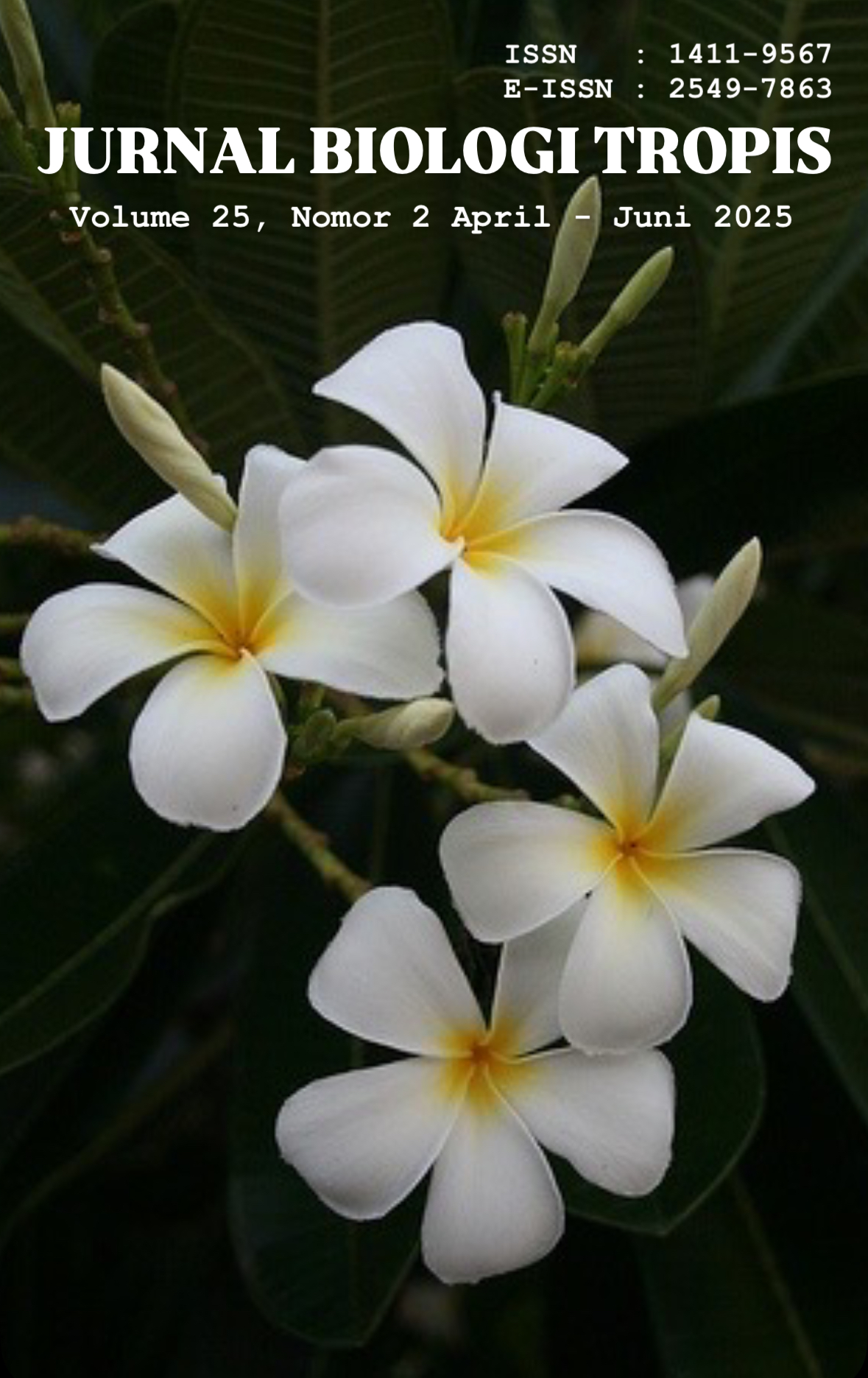
The Comparison of IC50 of Suji (Pleomele angustifolia) which is Extracted by Different Solvent
DOI:
10.29303/jbt.v25i2.9559Published:
2025-03-30Downloads
Abstract
The Determination both of IC50 of Suji (Pleomele angustifolia) and its phytochemical subtances content which extracted by a different solvent has been conducted. The aim of this research is to determine kind of solvent which achieve better result. The method used is laboratory experiments for phytochemical screening and antioxidant activity assay. This research consists of 2 (two) stages. First stage aims to obtain extract of suji by using certain solvent, and the second stage is carried out to examine secondary metabolite compounds of the extract using phytochemical screening and then to determine the antioxidant activity of extract using the DPPH method. This research used 2 kinds of solvent, ethanol plus ethyl acetate in the first sample, and the second one by ethanol only. Sample which extracted by ethanol plus ethyl acetate positively contains terpenoids, whereas flavonoid and alkaloids are detected in a significant number. The DPPH test results obtained the equation y = 0.3492x + 12,059, indicating that the antioxidant activity of suji which extracted by ethanol plus ethyl acetate is classified as moderate as the IC50 value of the extract of suji is108,65 ppm. The other sample which extracted just by ethanol also contains terpenoid, flavonoid, and alkaloid, but in a greater number. In the second sample also detected steroid compound which undetectable in the first sample. DPPH score in the second sample which extracted by ethanol. is y= 06352x + 18, 786. By using this equation we found 49.14 ppm as IC50 score. This score is classified as strong activity. This result shows that antioxidant activity of the second extract is stronger than the first one. The result also meaning that ethanol is more effective in extracting phytochemical compounds of suji than ethanol plus ethyl acetate.
Keywords:
Extract, phytochemical screening, Suji.References
Abasa, S., Ishak, P. (2023) Pengaruh Pemberian Ekstrak Daun Suji (Pleomele angustifolia) Terhadap Kadar Kolesterol pada Tikus Putih (Rattus norvergicus) PAPS Journal. 2(2).
Amalo, D., Rony S. Mauboy, Amor Karyawati, Maria T.L Ruma Alfred O.M. Dima, Fitri R. Saminda. (2022). Aktivitas Ekstrak Daun Suji(Dracaena angustifolia) Terhadap Daya Hambat Pertumbuhan Jamur Candida albicans. Jurnal Biotropikal Sains. 19(3)
Anonim. (2015). Tanaman Suji. http://digilib.unila.ac.id/9804/14/BabII.
Harborne, J.B. 1987. Metode Fitokimia Penuntun Cara Modern Menganalisis Tumbuhan. Bandung: ITB.
Ivanisova, E.I., Damgaliev, D., Konstovo, M. (2013). Antioxidant Activity Of Selected Plant Products. Journal Of Microbiology, Biotechnology And Food Sciences
Kurnia, LD., Ruga, R., dan Saleh, C. (2022). Jurnal Kimia Mulawarman, 20(1). doi : 10.30872/jkm.v20i1.1106
Lay, B.W. (1994). Analisis Mikroba di Laboratorium. Jakarta: PT. Raja Grafindo Persada.
Lenny, S. (2006). Senyawa Flavonoid, Fenilpropanoid & Alkaloid, Departemen Kimia
Mardawati, E., F. Filianty dan H. Harta. (2008). Kajian Aktivitas Antioksidan Ekstrak Kulit Manggis (Garcinia mangostana L.) dalam Rangka Pemanfaatan Limbah Kulit Manggis di Kecamatan Puspahiang Kabupaten Tasikmalaya. Hal. 4.
Narande, J.M., Wulur, A. and Yudistira, A. (2013). Uji Efek Antiinflamasi Ekstrak Etanol Daun Suji (Dracaena Angustifolia Roxb) Terhadap Edema Kaki Tikus Putih Jantan Galur Wistar, Pharmacon, 2(3).
Nuzulia, R. 2017. Pengaruh Ekstrak Daun Kemangi (Ocimum basilicum Linn) Pada Berbagai Konsentrasi Terhadap Viabilitas Bakteri Straptecoccus mutans. Jurnal Kedokteran di Ponegoro, 6(4)
Prangdimurti, E., Muchtadi, D., Astawan, M. dan Zakaria, F.R. (2006) Aktivitas antioksidan ekstrak daun suji (Pleomele augustifolia N.E. brown). Jurnal teknologi dan Industri Makanan. XVII(2): 79 – 86.
Putriyana (2023). UJI AKTIVITAS ANTIOKSIDAN EKSTRAK ETANOL DAUN SUJI (Dracaena angustifolia) DENGAN METODE DPPH (1,1-difenil-2-pikrilhidrazil). ZAHRA: JOURNAL OF HEALTH AND MEDICAL RESEARCH, 3(1), 86-97
Rivai, Harrizul, Ernira W.S., dan Rusdi, (2013). Pengaruh Perbandingan Pelarut EtanolAir Terhadap Kadar Senyawa Fenolat Total dan Daya Antioksidan dari Ekstrak Daun Sirsak (Annova muricata L.), Jurnal Sains dan Teknologi Farmasi, 18(1): 35-42.
Saifudin, A., Rahayu, V., dan Teruna, H.Y. (2011). Standarisasi Bahan Obat Alam. Graha Ilmu: Yogyakarta.
Senja, R.Y., Elisa I., Akhmad K.N., dan Erna P.S (2014). Perbandingan Metode Ekstraksi dan Variai Pelarut Terhadap Rendemen dan Aktivitas Antioksidan Ekstrak Kubis Ungu (Brassica oleracea L. var. Capitata f. Rubra). Traditional Medicine Journal,19(1):43-48.
Nortjie, E., Basitere, M., Moyo, D., Nyamukamba, P. (2022) Extraction Methods, Quantitative and Qualitative Phytochemical Screening of Medicinal Plants for Antimicrobial Textiles: A Review. Plants 11(15), https://doi.org/10.3390/plants11152011
Priyambodo, J., Sudarsono, & Rohman. (2014). The Antiradical Activity of Insoluble Water Suji (Pleomele angustifolia N.E. Brown) Leaf Extract and Its Application as Natural Colorant in Bread product. J.Food Pharm.Sci. 2: 52-56
Tiwari, P., Kumar, B., Kaur, M., Kaur G. & Kaur H (2011). Phytochemical Screening And Extraction: A Review. International Pharmaceutica Sciencia, 1 (1), 98- 106.
License
Copyright (c) 2025 Syamsul Bahri, Dadi Setiadi, Tri Ayu Lestari, Heru Setiawan, Muhammad Alfianul Hakim, Lalu M. Zidan Cahyadi

This work is licensed under a Creative Commons Attribution 4.0 International License.

Jurnal Biologi Tropis is licensed under a Creative Commons Attribution 4.0 International License.
The copyright of the received article shall be assigned to the author as the owner of the paper. The intended copyright includes the right to publish the article in various forms (including reprints). The journal maintains the publishing rights to the published articles.
Authors are permitted to disseminate published articles by sharing the link/DOI of the article at the journal. Authors are allowed to use their articles for any legal purposes deemed necessary without written permission from the journal with an acknowledgment of initial publication to this journal.
























