
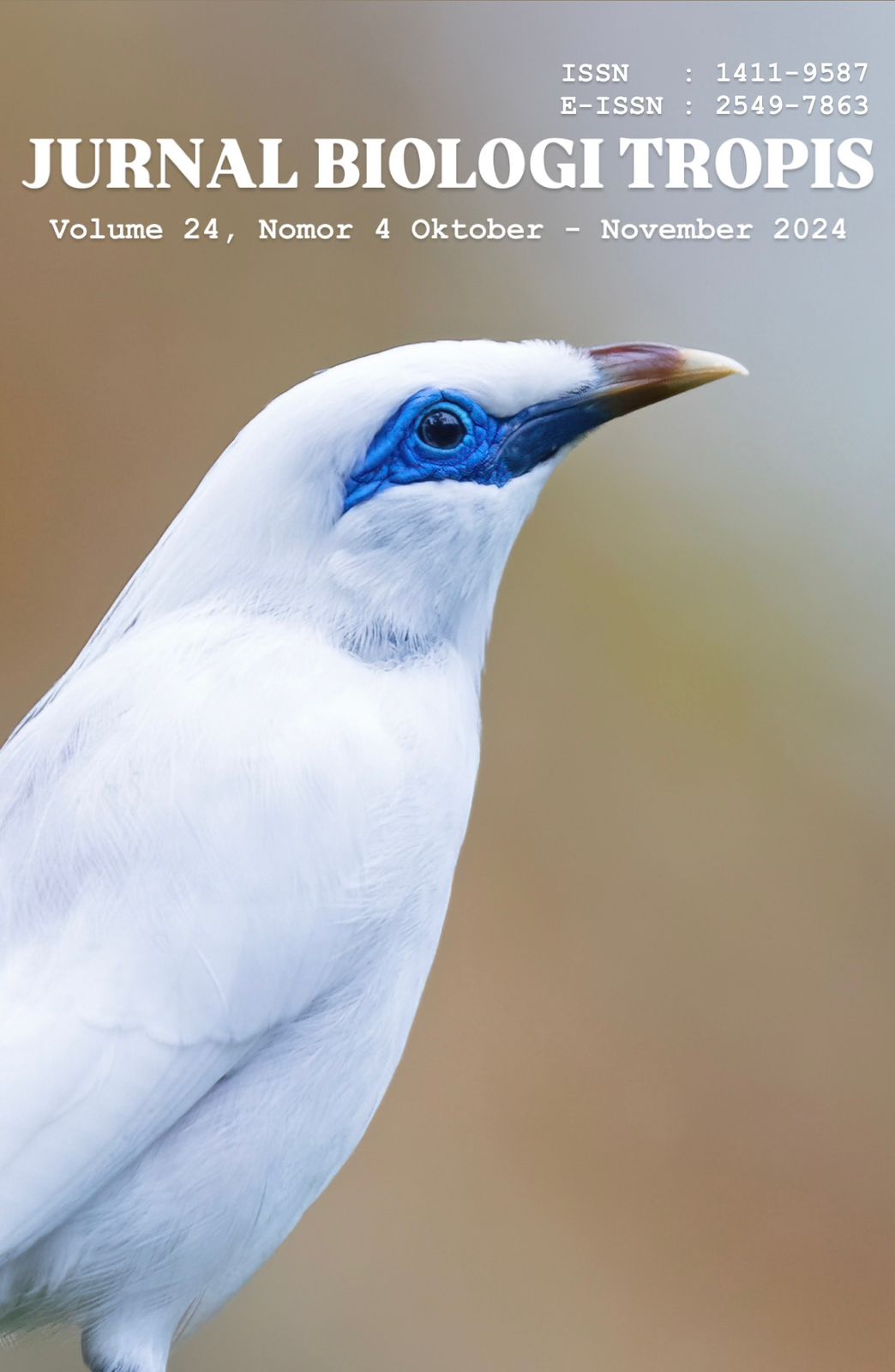
Vegetation Characteristics of The Nesting Area of The Orange-Footed Scrubfowl (Megapodius reinwardt) In Tunak Mountain Natural Tourism Park Central Lombok District
DOI:
10.29303/jbt.v24i4.7924Published:
2024-11-06Downloads
Abstract
Orange-footed scrubfowl (Megapodius reinwardt) is a protected species and needs to be preserved. They build mounds using leaves, twigs, plant litter and soil. The importance of plant vegetation around the Orange-footed scrubfowl nesting area while until this research was conducted no one had examined plant vegetation in Orange-footed scrubfowl nesting area became the background of this research. The data collection method of this research is by using the plotted method. Variables in this study include plant vegetation (tree diameter, number of individuals and tree species) and environmental data including temperature, humidity and light intensity. The results showed that the vegetation of Orange-footed scrubfowl nesting area in TWA Gunung Tunak has differences in species between one nest and another, but there are still many similar species. The diversity index shows that the vegetation around the nest is not diverse, ranging from 11-15 species with high dominance evenness. The species similarity index between inside the nest and outside the nest is high. This is also influenced by environmental factors that are not too different from one nest and another. Based on the results of the research that has been done, it is concluded that the vegetation of the gosong bird nesting area in the red foot of TWA Gunung Tunak has differences in species between one nest and another, but there are still many similar species.
Keywords:
Gunung Tunak Natural Tourism Park, Megapodius reinwardt, Vegetation Characteristics.References
Abdillah, W., Ekyastuti, W., & Arbiastutie, Y. (2022). Keanekaragaman jenis anggrek (Orchidaceae) di Kawasan Taman Wisata Alam Gunung Melintang Kabupaten Sambas. Jurnal Hutan Lestari, 10(4), 881-890.
Darwati, H., Ramadan, C. A. K., & Rifanjani, S. (2023). Keanekaragaman jenis serangga detritivor di Desa Pampang Harapan Taman Nasional Gunung Palung. Jurnal Hutan Lestari, 11(2), 316-326.
Ghufrona, R. R., Kusmana, C., & Rusdiana, O. (2015). Komposisi jenis dan struktur hutan mangrove di Pulau Sebuku, Kalimantan Selatan. Jurnal Silvikultur Tropika, 6(1), 15-26.
Harris, R. B. Birks, S. M. & Leach, A. D. (2014). Incubator birds: biogeographical origins and evolution of underground nesting in megapodes (Galliformes: Megapodiidae). Journal of Biogeography. 41(11), 2045-2056.
Hidayati, Z. H., Silamon, R. F., & Syaputra, M. (2018). Karakteristik sarang burung gosong kaki merah (Megapodius reinwardt) di jalur Teluk Ujung Taman Wisata Alam Gunung Tunak. Program Studi Kehutanan, 1–14.
IUCN. (2016). Megapodius reinwardt: The IUCN red list of threatened species 2016. Diakses dari: https://dx.doi.org/10.2305/IUCN.UK.2016-3.RLTS.T22734302A95081879.en.
Khairuddin & Yamin, M. (2019). Megapodius reinwardt conservation based on ecological knowledge of local people to support sustainable ecotourism on Moyo Island. Proceedings of the 2nd International Conference on Bioscience, Biotechnology, and Biometrics 2019. Diakses dari: https://doi.org/10.1063/1.5141302.
Nurjaman, D., Kusmoro, J., & Santoso, P. (2017). Perbandingan struktur dan komposisi vegetasi Kawasan Rajamantri dan Batumeja Cagar Alam Pananjung Pangandaran, Jawa Barat. Jurnal Biodjati, 2(2), 167-179.
Oktovianus, Arief, H., Hikmat, A., Hernowo, J. B., & Hermawan, R. (2017). Analisis keanekaragaman jenis tumbuhan pakan burung gosong kaki merah (Megapodius reindwardt) di Taman Wisata Alam Gunung Tunak. Agroprimatech, 1(1), 10–17. http://jurnal.unprimdn.ac.id/index.php/Agroprimatech/article/view/432.
Oktovianus., Harnius A., Aguas Hikmat., Jarwadi Hernowo & Rachmad Hermawan. (2018). Preferensi habitat burung gosong kaki merah (Megapodius reindwardt) di Taman Wisata Alam Gunung Tunak, Kabupaten Lombok Tengah, Provinsi Nusa Tenggara Barat. Media Konservasi, 23(3), 216-225.
Puspitasari, F. L., Syaputra, M., & Hadi, I. (2023). Mikrohabitat sarang burung gosong kaki merah (Megapodius reinwardt) di zona pemanfaatan Pulau Satonda Taman Nasional Moyo Satonda. ULIN: Jurnal Hutan Tropis, 7(2), 255. https://doi.org/10.32522/ujht.v7i2.12668.
Sari, F. W. (2022). Karakteristik gundukan dan mikrohabitat sarang burung gosong kaki merah (Megapodius reindwardt) di blok perlindungan Taman Wisata Gunung Tunak (Skripsi tidak dipublikasikan), Universitas Mataram.
Sari, F. W., Syaputra, M., & Webliana, K. (2022). Karakteristik gundukan dan mikrohabitat sarang burung gosong kaki merah (Megapodius reinwardt) di blok perlindungan Taman Wisata Alam Gunung Tunak (Artikel Universitas Mataram). URL: http://eprints.unram.ac.id/33182/2/JURNAL_FITRIANDIVA%20WIDIA%20SARI.pdf.
Subhan, S., Rais, M., Pratikino, A. G., & Erawan, M. T. F. (2022). Struktur populasi ikan endemik banggai cardinalfish (Pterapogon kauderni) yang diintroduksi di perairan Pulau Bokori – Sulawesi Tenggara. Jurnal Kelautan: Indonesian Journal of Marine Science and Technology, 15(1), 15–22. https://doi.org/10.21107/jk.v15i1.13576.
Yamin, M. & Khairuddin (2018). Distribution and survival of Megapodius reinwardt for ecotourism contributing on Moyo Island. Jurnal Biologi Tropis, 18(2), 189-199. DOI: 10.29303/jbt.v18i2.931.
Yuningsih, A., Hadi, I., & Syaputra, M. (2018). Populasi dan karakteristik gundukan sarang burung gosong kaki-merah (Megapodius reinwardt) di Kawasan Tanjung Pasir Taman Buru Pulau Moyo. Program Studi Kehutanan.
License
Copyright (c) 2024 Heny Wardani, M. Yamin, Khairuddin Khairuddin

This work is licensed under a Creative Commons Attribution 4.0 International License.

Jurnal Biologi Tropis is licensed under a Creative Commons Attribution 4.0 International License.
The copyright of the received article shall be assigned to the author as the owner of the paper. The intended copyright includes the right to publish the article in various forms (including reprints). The journal maintains the publishing rights to the published articles.
Authors are permitted to disseminate published articles by sharing the link/DOI of the article at the journal. Authors are allowed to use their articles for any legal purposes deemed necessary without written permission from the journal with an acknowledgment of initial publication to this journal.
























